Defaming Lady Arwa Mosque [Archives:2006/948/Reportage]
May 22 2006
 |
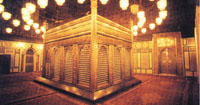
Jibla locals recall that 20 years ago they changed Lady Arwa Mosque in an effort to preserve it as a landmark, admitting that they unknowingly made mistakes, especially as there was no authority in charge of preserving the mosque.
The changes effaced and defamed important portions of the mosque's monuments. For example, the pond was reconstructed into a concrete water tank, over which another similar one was built, although many objected to the idea. Additionally, old bathrooms were modernized and iron doors replaced wooden ones.
Basalt and concrete arches were added to the mosque's southern section, the yard was concreted and new concrete columns were added as well.
Locals maintain that they made such changes only for repair purposes. This was the first phase of defaming the mosque's monuments, for which the Jibla Endowment Office and locals are held responsible.
The second phase began in 2001 and still is ongoing, wherein the mosque is under repair, a process funded by the Endowment Office, supervised by the Monuments Office and implemented by a contractor, all under the supervision of Ibb's local council as an authority to run the repair process.
According to several locals, the repair process began with the roof, as its northern section sprang a leak in the direction of Lady Arwa's shrine. The Endowment Office designated YR 6 million to repair the entire roof, making available a contractor to be supervised by Ibb's branch of the Public Authority for Preserving Historical Cities (PAPHC).
PAPHC head Ahmed Al-Nawa'a said its participation in the repair process was essential, as it knew the Endowment Office would concrete the roof. “We interfered in the matter, as the roof needed simple repairs. We dealt with the matter carefully and carried out repairs according to a study by the Endowment Office's Technical Department, which showed that the mosque would stand for a century and a half after such procedures,” Al-Nawa'a added.
However, the Endowment Office denied that its Technical Department conducted such a study. “There is a document stating that the Endowment Office would not take any responsibility other than funding the repair process as a condition,” the office clarified.
Jibla local council Secretary-General Dr. Farouq Aqeel said the council enforced itself in the repair process, assigning Al-Nawa'a to fully supervise the process, carry out studies and be in charge of the entire process. Therefore, he added, the local council dealt only with documents and studies presented by the PAPHC, but said it “had not received any documents or reports on the repair process from either party.”
Locals agreed that the repair process was that the roof's old plaster was replaced with new and that wooden boards were pulled out and replaced with new imported ones (which are identical to the old ones, according to Al-Nawa'a).
According to Arwa Historical Association and some other locals, the plaster was pulled out with mattocks, resulting in cracks in the walls, the prayer niche and the mosque's foundations. The PAPHC found that the new plaster was so fragile that a finger could scratch it. “If what they said was true, then the mattocks would have destroyed any decorations. However, they said the decorations were intact, which means they fabricated a lie,” the PAPHC stated.
Still, some locals maintain that the decorations were protected by wooden boards so mattocks could not reach them and only the wooden boards were destroyed when pulling out the plaster, so they were replaced. Some decorations were destroyed without reason, although they were in no danger.
The repair process failed to amend the water leaks but resulted in damage all over the mosque. According to the PAPHC, this is because the repair process stopped, whereas according to the Arwa Historical Association and the Monuments Office, supervisors conducted no studies on the repair process. For his part, the contractor claimed the plaster requires 10 years to become solid and effective.
The PAPHC denied that there were decorations in the roof's northwestern portion. “There were only wooden boards, which are modernized and bear no inscriptions.” Al-Nawa'a said, “The modern boards decayed due to rain so they were pulled out. The Endowment Office still keeps some samples of them as evidence of the validity of their procedures.”
Others think the decorations were ruined when pulled out harshly. “The decorations were supposed to be treated properly, such as providing them with anti-erosion substances. They still were firm and there was no need to pull them out. They had nothing to do with protection, as they were for ornamentation.”
Likewise, the mosque's yard with its four porches underwent repair without making due plans, according to the PAPHC. The porches consist of columns and arches representing the architecture of Al-Sulahi state. The eastern, western and southern porches were repaired. Each porch consists of seven columns and seven arches, most of which were replaced with modern ones, giving them another shape. They were made of round stone, with stone replacing red brick, employing cement instead of plaster.
The northern porch (the parlor) is the mosque's main front and consists of seven columns with its upper portion representing the crown of Al-Sulahi state. It was changed into another shape. The eastern portion of the last column cracked and so far has not been repaired.
Al-Nawa'a clarified that the three porches' red brick decayed due to erosion and other weather factors throughout previous centuries, causing the columns to slant. As for any plan or study, Al-Nawa'a said, “There was no need to conduct any study, as the columns were modern and made of cement. There still is one column in the northeastern section of the yard. Whoever says the columns are the same since the mosque was built is an idiot and an enemy of the PAPHC.”
However, locals and those in charge of the mosque said the three porches' columns were old and made of semi-circular stones, each two forming one round stone and stuck together with plaster. They were built as such, save one column which cracked 30 years ago and was rebuilt with ordinary stone and cement.
Moreover, Al-Nawa'a affirmed that cement never was used in reconstructing the columns and arches, as only plaster was used. However, he then confessed to using cement, which “was used as a connective substance nd what is important is that it should be noticed.” He added that the PAPHC used cement in implementing similar projects.
Arwa Historical Association head Abdulwahab Al-Khidairy said, “The PAPHC and the contractor destroyed the columns arbitrarily and without justification. They are held responsible along with the Endowment Office. It merely was a matter of money. Most of the columns were intact, save one east of the front porch, although it has not been repaired so far. Instead, it was eliminated totally and its place remains vacant.”
Monuments Office head Khalid Al-Ansi said, “Those who wanted to rebuild the column destroyed it, thinking it did not match the rest of the columns after it slanted. They tried to hide their mistake by all means. For that reason, we always say destruction work led to cracks all over the northern porch. Hence, the PAPHC had to fill the middle arch with stone and clay for fear the northern porch would collapse.”
That was the second phase of repairing the mosque, carried out by police officer and contractor Ghassan Humran, whose experience is unknown to anyone. Al-Nawa'a and engineer Ismail Shosha, PAPHC representatives, supervised the repair process, along with Endowment Office representative Abdulhamid Al-Ashwal, who Public Funds Prosecution accuses of stealing YR 1.5 billion in four years during the repair process.
Arwa Historical Association holds the contractor, PAPHC and the Endowment Office responsible and demands they be tried. The Monuments Office and the local council hold the PAPHC responsible and accuse it of not conducting studies on damages and mistakes during the repair process, as well as leaving the work without reason.
Al-Thaqafiyya newspaper issue 191 interviewed PAPHC General Director Dr. Abdullah Zaid and PAPHC projects director Khalid Jubari who confessed to the messy measures and lack of studies. Jubari stated, “The PAPHC in Ibb had not enough experience in dealing with repair processes hat happened, happened. More than one committee made a field visit to them and did not agree with what Ibb PAPHC did, as they did not depend on any study.”
Ibb Appeals Prosecution saw that the Endowment Office and the PAPHC were responsible for what happened and the case was referred to Ibb's East Court. Moreover, General Prosecution accuses the following individuals:
1- Abdulhamid Al-Ashwal, General Director of the Ibb Endowment Office
2- Ahmed Al-Nawa'a, PAPHC representative
3- Saddiq Hinaish, projects director at the Ibb Endowment Office
4- Khalid Al-Baz, accounting head at the Endowment Office
5- Khalid Al-Najjar, engineer at the Endowment Office
6- Ismail Shosha, engineer at the PAPHC
7- Akram Dhafer, technician at the PAPHC
All have been released on bail. Al-Ashwal exploited his post by signing contracts with two unqualified contractors to repair the mosque. By signing the contracts, he and the other accused wanted to get three percent of the funding as supervision allowances. This led to YR 21.4 million in damages to be paid from the state's budget.
Also, Al-Ashwal assigned the PAPHC the task of supervising the repair process only after making damages. The rest of the accused assisted him in preparing documents and completing contract signing procedures. The second accused was the one who suggested bringing in unqualified contractors.
Many say that perhaps the one who did not face any legal investigation and benefited much is contractor Humran, as he was not involved in signing any of the documents. Even when General Prosecution brought him, he had evidence enough to convict both the PAPHC and the Endowment Office.
Humran still is conducting repairs in the mosque and recently received another project to repair Ibb Mosque as a reward from government leadership, although the Endowment Office objected to dealing with him. Some say Humran has good offices to protect him from any legal investigation, while others say he has the ability to silence the most influential government figures.
For his part, Humran stated, “I am a businessman and I came here to gain. I work according to supervisors' directives, whether to repair or destroy. I cannot do anything without their approval.”
Regarding Humran's previous experience, Mr. Humran said, “I am no more than a laborer in market, brought in and hired by the Endowment Office, asking me to this and that. So I am not responsible for what happened to the mosque. The Endowment Office is 80 percent responsible, as it stopped the repair work and refused to pay the dues.”
The Monuments Office confessed before Prosecution that the repairs began from the top instead of from the bottom, which is why cracks occurred in the mosque's walls. The PAPHC also damaged its monuments by using cement. Therefore, the Monuments Office had to interfere via the Ministry of Culture to prevent such wrong repair work.
Due to differing views, the PAPHC officially announced that it will withdraw from supervising the repair process and thereby will not be responsible for what Humran does.
Local council Secretary-General Col. Ameen Al-Worafi played a large role in the repair process and in leaving Humran unchanged. He said, “The Monuments Office's withdrawal is unjustifiable. This authority had to conduct studies and supervise the repair process. It had to take the responsibility, not quit.”
Some people say the decision to make the PAPHC participate in supervising the repairs was an indirect insult to the Monuments Office, which decided to withdraw.
In 2003, repairs began from the mosque's foundations, according to the desire of the Monuments Office, which affirmed it would take entire responsibility for the repairs. The foundations are two floors deep in the ground and help remove sewage water via special canals. With the passage of time, house gutters were linked to these canals. Suddenly, gutter water began flowing here and there around the mosque, producing a hateful smell.
“The gutters' waste materials accumulated and decayed the canals' ground,” Al-Ansi explained.
Then came the process of repairing the mosque's caravansaries. Arwa Historical Association and the PAPHC accused the Monuments Office of destroying the caravansaries' walls and then rebuilding them, which Al-Ansi denied. On the other hand, the PAPHC accused the Monuments Office of causing cracks in the walls of the northern dome, which remains unrepaired.
In this regard, Al-Ansi said, “The dome was built on a lake of sewage water, so we dug a pit to save the dome. We then discovered an ancient construction under the dome's foundations. This was the area through which sewage waters flow. Afterward, the dome's foundations were separated from the canals by building concrete walls We did not pull out any stone from the dome We had asked the local council and the Endowment Office to solve the sewage water problems, remove the water tank and return it to its original shape, i.e., to be a pond. But the Endowment Office has not yet replied to our demand.”
——
[archive-e:948-v:14-y:2006-d:2006-05-22-p:report]